I label, therefore I am
📅 Sat 6 December 2025 at 06:48 GMT

Do you ever get scared in the dark? Everyone does. When you enter a house at night in the dark and you fumble looking for the light switch. That final microsecond between flipping the switch and the lights coming on. What are you actually scared of?
A large part of it is fear of the unknown.
When we don’t know what we could be potentially dealing with, our survival instincts kick in, and makes us fear the worst.
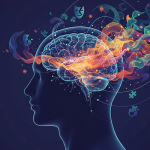
A scene from a horror movie. Something disturbing you heard in the news today. A previous bad experience. In that moment, your brain gives them all permission to run riot in your consciousness.
Until the lights come on, and your brain can confirm that everything is fine.
This sequence of events happens even though rationally, you know it’s extremely unlikely that anything nasty is lurking in the shadows. The root of it is a fear of the unknown – what might be waiting for you in the dark.
The healing power of a label
I actually see this a lot as a doctor. Patients come with a constellation of symptoms that they can’t make sense of. Much of the anxiety this causes really stems from a fear of the unknown. They are fumbling in the dark, with all their worst fears coming to the fore.
The moment the doctor is able to put the name of a disease to what the patient has been experiencing, it’s as if the light has been switched on and the patient can now at least see what they’re dealing with.
Sometimes I feel that my medical superpower is something as simple as the ability to offer a name – a label – for the patient’s condition. It’s so easy to do, relatively speaking. I mean, it’s not as difficult or heroic as actually curing the disease! Frankly, we don’t fully appreciate the value of naming things.
As humans, we need names for things. It’s a basic societal need. Everything must have a name. Otherwise, how can we discuss, share, research about it? We discussed this recently when Seth Godin gave a name – the shard moment – to the turbulence caused when a new disruptive technology is emerging.
Fun fact: There is a name for the study of names – it’s called onomastics!
Naming is part of the fundamental human need for identifying what’s around us, to know if it’s safe, or dangerous, or an opportunity, or a threat. Naming is so fundamental that the first thing a newborn baby needs is a name – even before Baby Smith’s first nappy change.
Where do names come from?
I have often wondered where do names come from? I mean, why is a tree called a “tree”? Or a house, called a “house”? OK, these contemporary English words are derived from ancient words in other languages such as Latin and German, but where did those ancient names come from? Who decided what “tree” means, and what “house” means, and why, and what right or authority did they have??
I find it interesting that in some languages such as Arabic and Hebrew, many of the words trace their origin to a root word with 3 or 4 letters. For example, in Arabic, everything to do with writing comes from the three root letters k-t-b. However, the question remains – why is it k-t-b and not b-k-t or any other combination of letters?
Ancient texts sometimes provide a clue. And sometimes, more questions.
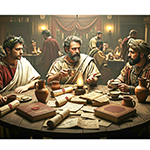
In the Abrahamic tradition, when God created Adam, one of the first things – and one of the few things, in fact – that God did before sending Adam to Earth was – according to the English translation – to teach him the names of everything. And then God made Adam repeat the names back to him, as a verification. It gives an indication of how important God thought names were.
But wait – names are a human construct, and they don’t exist without our human context. And Adam was the first human. So how did things already have names? Or does this mean that God assigned names to everything and taught Adam what the names are?
And what is meant by “everything”? Like, literally everything that existed in the universe? Or is the text rhetorical – it uses the word “everything” to signify a large number of names, but it means more precisely, “everything that Adam needed to know“? (A synecdoche, like “Lets go for a coffee” we examined previously.)
Apart from the linguistic questions, how about the implications of this statement? If Adam knew all the names, does the text support the theory that there was once a universal human language? And how come we are still inventing new names, if Adam already knew all the names? Have some names been forgotten? Or does new knowledge mean that new names are required? Quite often, a text like this can trigger more questions than what it is willing to answer!
In any case, it seems this new viral app “Adam” was launched on Earth preloaded with a dataset of names of everything it might encounter – a primordial semantic knowledge base of label-value pairs – because presumably, names would prove to be essential for its survival.
A final thought
Labelling things with good descriptive names is a skill which we need to get better at. I am trying to be an avid labeller – and hopefully my patients will appreciate my diagnostic skills! Also, many of my posts – including this one – involve giving a name to something we have already observed, because this helps us understand and interact with what may or may not be lurking in the shadows.
Sometimes people are scared of assigning labels in case the meaning of the label does not fully or correctly describe what is being labelled. In my field, a misdiagnosis can delay treatment. Some labels – for example, stereotypes – can be misused, especially when they reduce a person rather than illuminate a situation. This concern highlights just how powerful labels can be.
However, I am seeking labelling that is descriptive, clarifying, and humane. Wrong labels can be changed, just like a diagnosis can be revised, and even Baby Smith is allowed to change their name in the future! In most cases, the benefits of assigning a name, or a label, outweighs the risks. Just like flipping a switch in the dark, naming something turns on the lights.
“I label, therefore I am” is my twist on the statement by the French philosopher Descartes who said in Latin, “Cogito, ergo sum” – “I think, therefore I am.” By changing it to “I label, therefore I am”, we’re saying that naming and labelling phenomena around us is as basic as the ability to think. And like thinking – labelling with names and being able to use them is part of what makes us human. It was Adam’s distinguishing feature.
The only remaining question is: What are you going to name today?
And that’s A Deeper Thought.

Clarity is a daily practice
One deeper thought, delivered each morning, to help keep your thinking sharp and intentional.
 Join the conversation on