80 Shades of Balagha
📅 Sun 6 September 2026 at 15:55 BST

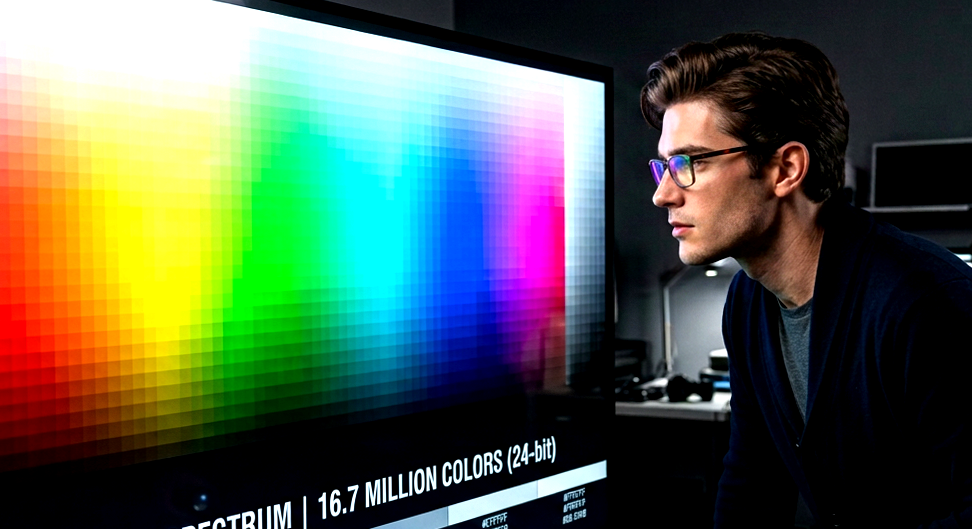
How many colours can the human eye distinguish?
I can honestly say that in over 35 years of studying science, anatomy, physiology, and medicine, I have never really thought about it.
Have you?
What I mean is – how many colours can a human reliably tell apart? The textbooks say the eye can perceive somewhere in the region of 1-10 million different colours. Standard TVs can now produce 16.7 million colours, and the newest ones over 1 billion.
But that’s not what I’m asking.
You take a piece of white paper. And you mark or write in different colours and shades. And you ask someone to tell one colour apart from another. How many colours and shades can you use, so that people can still tell them apart?
The answer is surprisingly small!
A Simple Ask
I am creating the Encyclopedia of Arabic Rhetoric as part of my PhD research into Arabic rhetoric (al-balāgha). So far, I have collected information about 80 rhetorical devices.
I want to assign each rhetorical device a “signature colour” so it would have a visually consistent appearance wherever it is used. One device, one colour. Consistent across the Encyclopedia, the Taxonomy of rhetorical devices, and the annotation system.
How difficult can that possibly be? Just pick 80 random colours. You have over a million to choose from.
In fact, like TVs, websites such as my Encyclopedia can use any out of precisely 16,777,216 (16.7 million) individual colours – and that number goes up to 4,294,967,296 (4.29 billion) colours if you add in different levels of transparency.
How difficult can it be? Well, turns out, it’s not that simple!
The Problem With Colours
When you start writing on a white screen or paper, you introduce certain constraints into your colour choice. Firstly, you can’t have colours that are too close to white, as the eye can’t read the faint letters. You have to check the coloured text is clearly readable against a white screen or paper.
Rather than leaving it to chance, there’s actually a mathematical formula called the WCAG white contrast ratio which goes from 1:1 for pure white (no contrast) to 21:1 for pure black (total contrast). A computer can calculate the ratio for any colour for you. The ratio needs to be more than 4.5:1.
In one fell swoop, that design threshold wipes the smile of bright-but-impractical colours out of your eyes’ 1 million colour range. We don’t want neon yellows in this Encyclopedia, thank you.
Secondly, you can’t co-locate colours that are very similar. Two devices side-by-side must have different colours to allow them to be easily distinguished. In fact, I don’t want two similar colours at all, anywhere in the Encyclopedia. It’s very easy to end up with subtle shades of blue, green, and red – technically different colours, but as functional as a chocolate teapot. We want maximum colour separations.
What I never knew before today, is that there are mathematical formulae, such as the – CIEDE2000 ΔE00 – that can calculate how “visually separated” any pair of colours is. There’s even a geekly Wikipedia page dedicated to Colour Distance.
Again, a computer can calculate the visual separation between one colour, and all 79 of its neighbours. You need a colour separation of more than 15 to be able to easily tell colours apart quickly and reliably.
So if I want Encyclopedia users to be able to almost intuitively associate a colour with a rhetorical device, the colours can’t be too light, and all the 80 colours must be different. We’re going to be squeezing those tubes of 3 primary colours to their limits this time.
“Show Me My 80 Shades of Balagha!”
I don’t normally spend much time thinking about the carbon footprint of AI. But today I am feeling a little guilty.
I’ve spent the last 24 hours with paid versions of ChatGPT, Claude, and Perplexity all open simultaneously on my computer, and all processing through 4,294,967,296 colours with their corresponding WCAG white contrast ratios and pairwise CIEDE2000 ΔE00s, all coming back and telling me it’s not physically possible to have (1) a contrast ratio of 4.5:1 or more and (2) pairwise CIEDE2000 ΔE00s more than 15, and (3) to generate 80 unique colours with those constraints.
And me whipping the AI into submission, flatly refusing to accept that out of 4.29 billion colours, the system won’t let me have a measly 80 for my Encyclopedia and my fledgling little rhetorical devices.
Let’s just say that some CPUs and GPUs got overheated over this…
In fact, you can try it for yourself in any AI: “Give me 80 unique colours with a WCAG white contrast ratio more than 4.5:1 and pairwise CIEDE2000 ΔE00s more than 15.”
The Answer
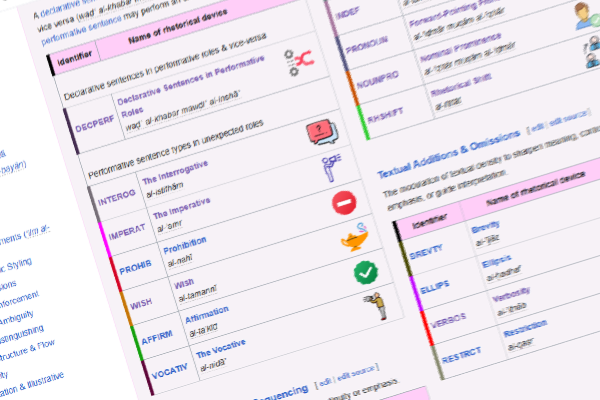
Ultimately, I had to relax the criteria somewhat to get my 80 colours. Slightly less contrast. Slightly less colour separation.
And even then, a mathematically perfect set of colours isn’t necessarily a set of colours that is aesthetically pleasing or functionally useful… so – it’s back to the drawing board. Again. And again. And again.
But to answer my original question: when you (i) want to be able to tell different colours apart, (ii) especially when using shapes or letters of a particular font size, (iii) against a white background, (iv) quickly, (v) in the real world (not in a laboratory), and (vi) you need the colours to have meaning, and (vii) for them to support a classification system, and (viii) to look good… the practical upper limit is around 90-100 colours. Did you know the question was so complex?
I never thought that on the way to becoming an expert in Arabic rhetoric, I would first need to become an expert in … <checks notes> … colour separation theory!

Stay connected?
I send a short daily idea each morning. No noise. No ads. Just one deeper thought.
 Join the conversation on